
One percent better
 I have consumed a lot of self-improvement books.
One of the common tropes is the “One percent better” saying.
Very common. Not as common as the Roger Bannister four-minute mile trope. But common, nonetheless.
This ‘one percent rule’ is probably older than dirt, Ptolemies probably preached it to eager Alexandrians, but I think it originated in my modern consciousness with the book Atomic Habits by James Clear.
A decent read. Probably better as an audio book. A bit preachy and breathless like most self-help books, it’s in their nature, part of the schtick.
But I digress.
The one percent rule.
This is how it goes, and I quote, “If you can improve by just one percent a day, you’ll be 37% percent better at the end of the year!”
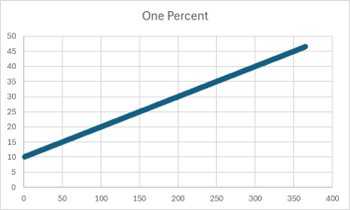
The point the one percent rule is trying to make is that small changes stack up over time. In this case the supposition, as preached, is that if you improve by one percent every day for a year, then at the end of the year you will have improved by 36.5% – which is the simple math of point-oh-one times 365.
So, If I am at an arbitrary level in some quality or capability of, let’s say, ten, to keep the math easy, and I improve by one percent on day one I am now at a capable level of ten point one.
One percent better.
On day two, I add another one percent and now my capability rises to ten point two. Hoorah!
If you were to plot this on a graph it would be a nice, clean, straight line marching up and to the right at one percent per day.
For the non-remedial-mathy among us you’ll notice that this version of the rule of one percent better is simply additive. Meaning we are only claiming the original one percent of the original value.
We are not compounding the one percent on the improvements. That’s a different trope altogether. They typically tell that trope when they talk about investing. For example the story about the grains of sand or the rice on the chessboard squares.
In those stories the lesson is the power of compounding interest.
Because if you were able to improve one percent on the previous improvements you get a really cool number.
Are you ready?
OK.
If, as before, I start with a capability value of ten and I compound the daily one percent improvement, at the end of the year I have a capability of, wait for it…
Eleven quadrillion, seven hundred eighty-three trillion, seventy-eight billion, five hundred ten million, one hundred forty-nine thousand, nine hundred.
Which is way better than 36.5
While I wholeheartedly agree with the premise that small, consistent efforts produce great long-term results. I don’t think the one percent-rule is quite that simple.
In reality, as we athletes know, improvement is much trickier.
It does not follow a straight line and it is not additive.
It is, in fact, some version of an S curve. Typically, the improvement starts slow, then accelerates, before hitting a point of diminishing returns where it slows and stops.
So you get less than one percent improvement in the beginning and at the end, but probably more than one percent improvement in the middle.
That is why when you take on a new capability-based project, let’s say you decide to learn how to play the tuba, your progress will be a maddening struggle for the first few weeks. You may get frustrated and want to give up. But, at some point something clicks, and the progress is rapid, and at the end of that year, with consistent daily effort, you’re pretty good at the tuba.
But you probably won’t make the first chair in the symphony.
Because another thing the one percent rule misses is that you have a starting point, a starting state. And that starting state has built in constraints. Maybe you have a bit of arthritis in your pinky finger from a fishing derby accident when you were four. That unfortunate flaw is going to keep you from mastering some of the notes in Beethoven’s ninth.
So each one of us is starting the game with a certain base level of capability and a number of constraints that can change the shape of our S-curve.
As athletes we see this as well. Some people are just born with a better tool kit than others.
Every one of us has a different curve based on our starting point and our ceiling.
Capability, or capacity, is another curve. This curve is a normal distribution.
If you were to quantify and plot ten-thousand-people’s starting, innate capabilities on a piece of graph paper, most of us fall in the fat middle. There are a few lucky or unlucky outliers who occupy the edges.
But does any of this matter to the self-help premise of one percent better?
Can you work harder to get better? Or, is your achievement level predestined by your potential?
Nature or nurture?
The answer is both.
The first chair tuba player and the Olympic athlete have a happy combination of inherent capability plus the work ethic to realize it.
That’s, I guess, the bad news, if we must have bad news. You can’t outwork your inherent constraints. You have both a starting point and a built-in upper limit to your capability.
But, you can get the best out of YOU with consistent work.
And that will put you ahead of all the pedestrians occupying the middle of the curve with you.
If you’re up against someone with the same capability, you can put in more work and more consistency than them, and you will probably beat them in a race.
The challenge is that when you get towards the top of the S-curve there are diminishing returns. The same one percent effort produces less improvement.
You’ll always be stuck within the constraints of your curve unless you can find some sort of breakthrough to get to the next level. This is what all the ‘hack’ talk is about. Shifting the curve.
That’s why we thrash around when we get to that point trying to find some way to get back to the rapid improvement part of the curve.
Maybe the solution is a coach. Maybe it’s a methodology. Maybe it’s mind control. How can we shape the curve to learn more faster?
To improve faster.
Professionals try to extend their curves by committing every second of every day to their art. They are not the one percenters. They are the one hundred percenters.
That’s a big choice. Directing one hundred percent of your life force at a single capability facet.
That’s when they start preaching ‘sacrifice’.
Anyhow…
What does all this mean for us run-of-the-mill, down-in-the-muck types?
Well, I have good news.
The good news is that there is good news.
If you understand the S-curve and are willing to push through that early part of the learning curve, whether it’s running or tuba, if you stay consistent with your effort, long enough, you will get to that middle part of the S-curve, which is rapid improvement.
And then it is fun.
You find that place where there is a breakthrough every week and a personal record around every corner.
This, my friends, is a universal truth.
If you stick with it, by the time the curve starts to flatten out, you will have somewhere around eighty percent mastery of that thing. And that is further than most people ever get. Being in the top 20% is not a bad place to be in most endeavors.
But then you will reach a point where you can’t outwork the curve. The curve will force you to look at your constraints. That’s part of the journey.
So my friends, yes, small habits, small daily efforts and consistency do unlock steady and predictable improvements. You can learn how to do almost anything. And your eighty percent mastery may be pretty good.
This isn’t just for new habits. The same curve applies to bad habits. If there is some behavior you want to change you have to work through that slow, initial flat spot in the curve, stick with it and you will ultimately find some form of success.
What do you do with this knowledge?
Well, you could learn something. Take it for a spin. Be consistent and reap the rewards. Start stacking one stone on top of another, and if you get knocked down, start over. That first eighty percent is there for the taking.
But don’t expect it to be linear. Don’t expect it to be infinite.
And if you invest those ten dollars at one percent a day compounded you can end up with an eleven quadrillion, seven hundred eighty-three trillion, seventy-eight billion, five hundred ten million, one hundred forty-nine thousand, nine hundred nest egg. .
Or maybe just one percent better.