
Life Design
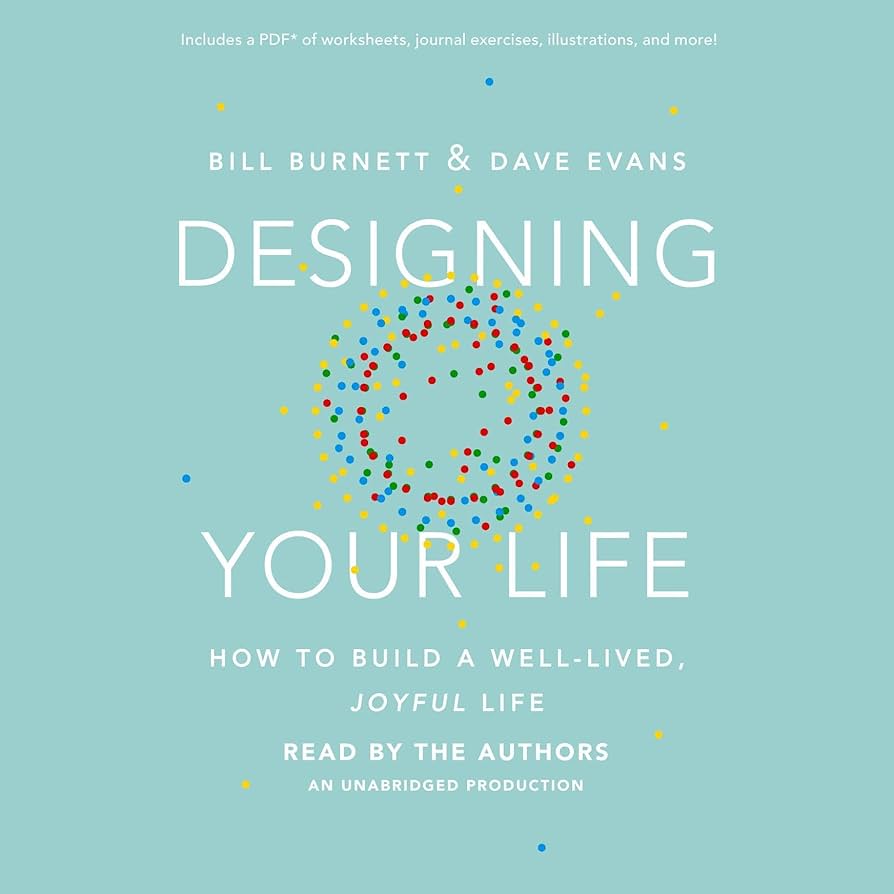 I’ve been listening to an audio book called “Designing Your Life” written by Dave Evans and Bill Burnett, two guys from the Stanford Design School that was published in 2016.
This is one of those ‘when the student is ready the teacher will appear’ moments for me.
I find myself in a transitional period in my life journey and this book hit at the right time. Very helpful.
And, as it turns out, I invented design thinking.
No. Seriously. I did.
As I was listening to these guys walk through their process, I thought to myself “Hold on. This all seems really familiar.” The reason it sounded really familiar is that I wrote a series of three articles on RunRunLive many moons ago that encapsulated a similar design process.
Here are the links to those three posts.
https://runrunlive.com/life-balance-a-primer
https://runrunlive.com/it-all-starts-with-self
https://runrunlive.com/the-system-theory-of-self
At the time I was trying to figure out how to find that ever-elusive “Life balance”. The concept of using a methodology to optimize your life was something that I had been noodling on in long runs for many years.
In these three posts I finally wrote it down.
My theory leaned on what I learned about system dynamics in engineering school and the optimization concepts I worked with in a business setting. These two concepts, combined with the need to have some sort of compelling purpose for the design, made for a fairly lucid understanding of the challenge and how to optimize for a better path forward.
At the time I was synthesizing what I had been thinking about for years. How to be rational about your career and life choices so that they align with what you find personally important, in a rigorous way, and then to act on them.
So – there you go. I invented design thinking.
This book “Design Your Life” also 😊 has a good framework for these kinds of decisions. It was developed for the Juniors and Seniors at Stanford to help them answer the question, “What do I want to do with my life?”
Which we all know from experience is a terrifying question.
The tools and methodology in this book are focused on that cohort, and spend a lot of energy on ‘choosing a career’ types of decisions, but are generally applicable to any transition point in life where you are trying to find a path forward.
Because transition points are always a challenge. They aren’t always planned. They sneak up on you. When you start thinking about these types of problems, they get big and emotion-filled very quickly. Then you are unable to find a path forward or take action, you ignore the looming transition and try to hide from it.
The question, “What should I do with the rest of my life?” is fraught. There are unnecessarily stressful built-in assumptions there. For example, you don’t have to make a ‘forever’ decision for the rest of your life. It can be a simple as “What do I want to try next?”.
The original question also implies that there is one big, perfect answer that you need to find.
There is not.
Do you think it’s fair or smart to ask yourself to select one from an infinite sea of choices and stick with it forever?
What I found is that when confronted with infinite choices I tend to freeze like a deer in the headlights and go into reactive mode. Which takes my power away and makes me miserable.
Dave and Bill also frame what they call ‘gravity problems’. The joke is a person will come to you and say “I was running up this big hill and got winded and had to stop. Therefore: Gravity is the problem! We need to fix the gravity problem before I can exercise.”
Obviously, we can’t fix gravity. There is no point in fixating on gravity. Instead of spending your energy bemoaning problems that can’t be fixed, we can redefine the problem to come up with other potential solutions and actions. We can train more. We can lose weight. We can find a less steep hill. But we shouldn’t waste time trying to fix gravity.
The important point here is that the way you frame the problem makes all the difference.
In my life I can give examples of how I was doing this. You probably can too. How about “The traditional publishing business is broken so there is no way to write a novel and get it published anymore.”
The traditional publishing world is dead, but that shouldn’t stop you from writing your novel.
What I did was start a fiction podcast, build an audience of 13,000 listeners a month, convert it to a novel and sell it directly to that audience.
Point being, I can’t fix the death of traditional publishing. But I can redefine the problem as “I want to write and publish my novel.” Then take actions that eventually get me to that point. And more importantly, take control and take action. (More on taking action in a minute)
These Stanford guys provide a methodology couched in the tenants of design thinking. This way you proactively come up with your own plans, and that is very empowering.
Right! Let’s cut right to the process.
The first step is to Start Where You Are
Much as I did in my old articles, the book suggests four areas of life (health, work, play, and love) to appraise and honestly grade your satisfaction in each. This will give you an idea of what makes you happy and where you need help.
Second step Building a Compass
In this step the book asks you to journal a description of your “Life View” and “Work View”. This exercise is a basic summary of what is important to you, what you find joy in, what you don’t.
Then read them over to see what the common themes are. Especially if you are still in your career, finding overlaps will give you some directional insights on things to pursue going forward.
Third step is Wayfinding
The exercise is to keep a “Happiness Journal” where as you go through your day you capture those moments when things are good (and bad). Basically, track your daily activities and see where you are engaged or even in flow. This is an exercise in looking for clues to what make you tick.
Fourth step is Getting Unstuck
In this step you take what you learned from your preferences discovered in the previous exercises and do a bunch of mind mapping to come up with wild ideas. For instance, you were happy walking the dog in the woods, so you ideate… “I’m going to become a sherpa in Tibet for Everest expeditions!”
But, in all seriousness, mind-mapping is a great tool to come up with ideas and the sillier and more creative you can be allows you to unlock parts of your creativity that lead to real insights.
Fifth step Design Your Lives
This is where you look at everything you have come up with so far and choose a manageable number of these ‘future you’ ideas. For each of these you create a plan. ‘Plan’ in this case being a fairly loose set of characteristics around what walking that path would take. Then, looking at the plans, you rate them on a few important characteristics.
The result is 3 potential new directions for your life.
Sixth step Prototyping
I think this is probably the most important part of this book. We all get the advice to ‘take action’. It’s easy to say. But hard to do. Especially when the problem is framed as “Choose what you want to do with the rest of your life.” The ‘take action’ advice then appears as ‘throw 100% of your energy, time and capital at one thing until you win or fail!’ Which is a horrible, terrifying decision.
What if, instead, you could test each of your ideas? What if you could find a way to be an intern sherpa for a few months? This is an eye-opening concept! You don’t need to choose one thing forever. Just find a reasonable way to test the concept and chances are that small action will lead to serendipity and you’ll discover paths you never knew existed.
The other powerful part of this is that prototypes are time bound. You can set your intent to try something for six months or a year or five and then decide to try something else. It’s not an all-or-nothing proposition and becomes much less risky and more digestible. You retain your power of choice even in your decision.
I’ll go back to my earlier example. When I started the After the Apocalypse fiction podcast in 2020 with the ultimate goal of creating a series of 5 novels, I gave it 6 months and $1,000.
As it turned out Spotify started to recommend the show and about 4 months in the number of listeners shot up to where it is now. And I kept it going. Otherwise, I may have dropped it at the end of season one and pivoted to something else.
But the point is find some way to prototype the life design ideas that you want to test. This way you can limit the damage that a poor choice of action may result in.
Learn from it and take up the next prototype.
Jobs
The rest of the book talks about how the job-seeking process is totally broken and how to design around that, most notably by interviewing people in those areas of interest to get ideas. This, while you may not need a job, is always a great way to learn. Talk to people. This also leads to a discussion around building a team to help you through life.
Failure Immunity
Another good concept they talk about in this book is how to cultivate failure immunity. This could be and may be the topic of an entire discussion.
I’ll start with my editorial.
Our culture around failure, (at least here is the States), is toxic. We say things like ‘learn from failure’ and ‘fail fast’ and ‘fail to the top’. While our actions are completely at odds with this. In our actions we gleefully seek and punish and shun any whiff of failure.
Failure as a concept is safe. Failure in practice, is both culturally, and personally destructive.
Any full life will have plenty of failure in it. In the book they give strategies on how to be prepared for failure and course correct quickly.
With that I’ll wrap this article up. This book is a great reminder that your future, what you do next, and your happiness is entirely up to you, and you can design, for the most part, a life that is purposeful and fulfilling, resilient, and relatively happy.
Your goal should not be constant happiness. That’s not how life works. Life has its ups and downs and you’re always going to have challenges. The trick is to build a toolset to help you proactively manage around those ups and downs.
In reality there is no one, perfect, forever, future plan for you. It’s going to change as your life changes. But as your seasons of life go by you can recalibrate with a bit of proactive life design. A good cadence for this review is suggested by the authors at no more than every 5 years.
So, talk to people, read books, and take actions on your ideas to test them out.
I wish this course was available to me when I was an undergraduate. It would have saved me lot of thrashing and suffering.